Showing posts with label depreciation expense. Show all posts

Tuesday, April 30, 2019

Waylander Coatings Company purchased waterproofing equipment on January 6 for $320,000

Waylander Coatings Company purchased waterproofing equipment on January 6 for $320,000. The equipment was expected to have a useful life of four years, or 20,000 operating hours, and a residual value of $35,000. The equipment was used for 7,200 hours during Year 1, 6,400 hours in Year 2, 4,400 hours in Year 3, and 2,000 hours in Year 4.

Instructions
1. Determine the amount of depreciation expense for the years ended December 31, Year 1, Year 2, Year 3, and Year 4, by (a) the straight-line method, (b) the units-of-activity method, and (c) the double-declining-balance method. Also determine the total depreciation expense for the four years by each method. The following columnar headings are suggested for recording the depreciation expense amounts:

Depreciation Expense Year Straight-Line Method Units-of-Activity Method Double-Declining-Balance Method


2. What method yields the highest depreciation expense for Year 1?
3. What method yields the most depreciation over the four-year life of the equipment?


Answer:
1.
a. Straight- b. Units-of- c. Double-
Line Activity Declining-Balance
Year Method Method Method
Year 1 $ 71,250 $102,600 $160,000
Year 2 71,250 91,200 80,000
Year 3 71,250 62,700 40,000
Year 4 71,250 28,500 5,000
Total $285,000 $285,000 $285,000
Calculations:
Straight-line method:
($320,000 – $35,000) ÷ 4 = $71,250 each year
Units-of-activity method:
($320,000 – $35,000) ÷ 20,000 hours = $14.25 per hour
Year 1: 7,200 hours × $14.25 = $102,600
Year 2: 6,400 hours × $14.25 = $91,200
Year 3: 4,400 hours × $14.25 = $62,700
Year 4: 2,000 hours × $14.25 = $28,500
Double-declining-balance method:
Year 1: $320,000 × [(1 ÷ 4) × 2] = $160,000
Year 2: ($320,000 – $160,000) × [(1 ÷ 4) × 2] = $80,000
Year 3: ($320,000 – $160,000 – $80,000) × [(1 ÷ 4) × 2] = $40,000
Year 4: ($320,000 – $160,000 – $80,000 – $40,000 – $35,000) = $5,000
Note:  Book value should not be reduced below the residual value of $35,000.
2. The double-declining-balance method yields the most depreciation expense in 
Year 1 of $160,000.
3. Over the four-year life of the equipment, all three depreciation methods yield 
the same total depreciation, $285,000, which is the cost of the equipment of 

$320,000 less the residual value of $35,000.

Thursday, April 18, 2019

Dexter Industries purchased packaging equipment on January 8 for $72,000. The equipment was expected to have a useful life

Dexter Industries purchased packaging equipment on January 8 for $72,000. The equipment was expected to have a useful life of three years, or 18,000 operating hours, and a residual value of $4,500. The equipment was used for 7,600 hours during Year 1, 6,000 hours in Year 2, and 4,400 hours in Year 3.

Instructions
1. Determine the amount of depreciation expense for the three years ending December 31 by (a) the straight-line method, (b) the units-of-activity method, and (c) the double-declining-balance method. Also determine the total depreciation expense for the three years by each method. The following columnar headings are suggested for recording the depreciation expense amounts:

Depreciation Expense Year Straight- Line Method Units-of-Activity Method Double-Declining-Balance Method

2. What method yields the highest depreciation expense for Year 1?

3. What method yields the most depreciation over the three-year life of the equipment?


Answer:
1.
a. Straight- b. Units-of- c. Double-
Line Activity Declining-Balance
Year Method Method Method
Year 1 $22,500 $28,500 $48,000
Year 2 22,500 22,500 16,000
Year 3 22,500 16,500 3,500
Total $67,500 $67,500 $67,500
Calculations:
Straight-line method:
($72,000 – $4,500) ÷ 3 = $22,500 each year
Units-of-activity method:
($72,000 – $4,500) ÷ 18,000 hours = $3.75 per hour
Year 1: 7,600 hours × $3.75 = $28,500
Year 2: 6,000 hours × $3.75 = $22,500
Year 3: 4,400 hours × $3.75 = $16,500
Double-declining-balance method:
Year 1: $72,000 × (2 ÷ 3) = $48,000
Year 2: ($72,000 – $48,000) × (2 ÷ 3) = $16,000
Year 3: ($72,000 – $48,000 – $16,000 – $4,500) = $3,500
Note:  Book value should not be reduced below the residual value of $4,500.
2. The double-declining-balance method yields the most depreciation expense in 
Year 1 of $48,000.
3. Over the three-year life of the equipment, all three depreciation methods yield
the same total depreciation, $67,500, which is the cost of the equipment of 
$72,000 less the residual value of $4,500.


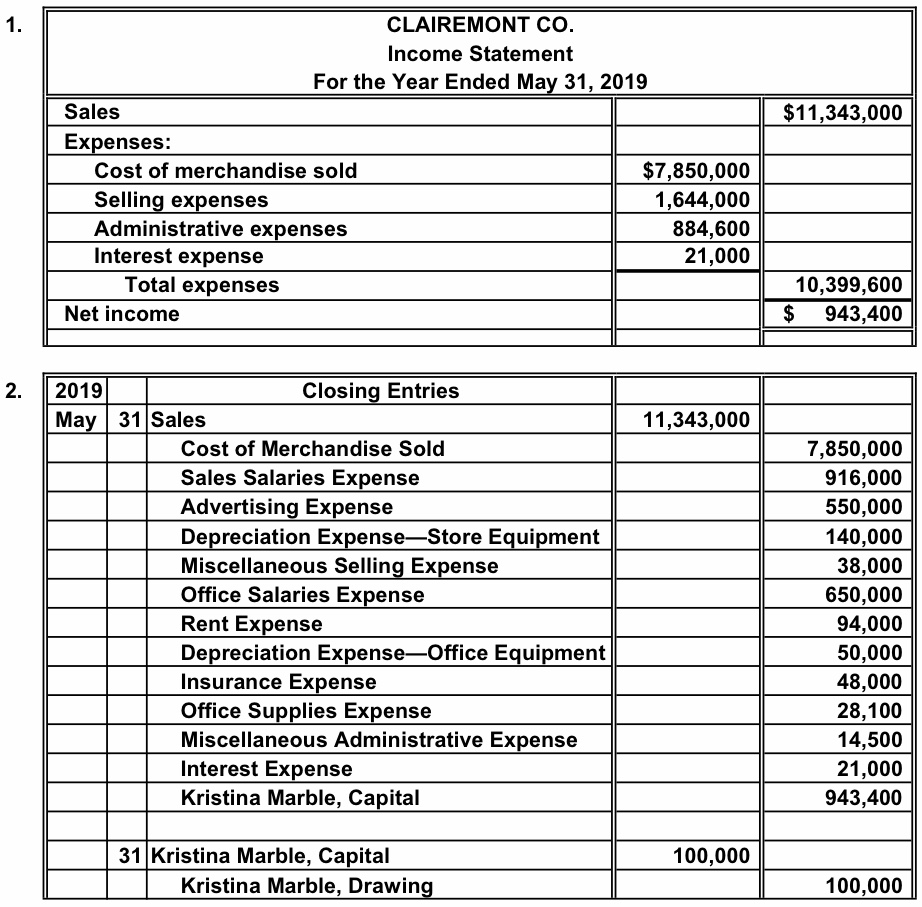
Selected accounts and related amounts for Clairemont Co. for the fiscal year ended May 31, 2019, are presented in Problem 6-5A.

Selected accounts and related amounts for Clairemont Co. for the fiscal year ended May 31, 2019, are presented in Problem 6-5A.

Instructions
1. Prepare a single-step income statement in the format shown in Exhibit 12.
2. Prepare closing entries as of May 31, 2019.


Answer:
1.
Sales$11,343,000
Expenses:
Cost of merchandise sold $7,850,000
Selling expenses1,644,000
Administrative expenses884,600
Interest expense21,000
Total expenses10,399,600
Net income$ 943,400
2.  2019
 May 31 Sales11,343,000
Cost of Merchandise Sold7,850,000
Sales Salaries Expense916,000
Advertising Expense550,000
Depreciation Expense—Store Equipment 140,000
Miscellaneous Selling Expense38,000
Office Salaries Expense650,000
Rent Expense94,000
Depreciation Expense—Office Equipment 50,000
Insurance Expense48,000
Office Supplies Expense28,100
Miscellaneous Administrative Expense 14,500
Interest Expense21,000
Kristina Marble, Capital943,400
31 Kristina Marble, Capital 100,000
Kristina Marble, Drawing100,000

Monday, December 17, 2018

On December 31, a business estimates depreciation on equipment used during the first year of operations to be $13,900.

On December 31, a business estimates depreciation on equipment used during the first year of operations to be $13,900.

a. Journalize the adjusting entry required as of December 31.

b. If the adjusting entry in (a) were omitted, which items would be erroneously stated on (1) the income statement for the year and (2) the balance sheet as of December 31?


Answers:
a.  Dec. 31 Depreciation Expense13,900
Accumulated Depreciation—Equipment 13,900
Depreciation on equipment.
b. (1) Depreciation expense would be understated. Net income would be 
overstated.
(2) Accumulated depreciation would be understated, and total assets would 
be overstated. Owner’s equity (owner’s capital account) would be overstated.