Showing posts with label inventory balance. Show all posts

Tuesday, January 1, 2019

Assume that the business in Exercise 7-9 maintains a perpetual inventory system. Determine the cost of merchandise sold for each sale

Assume that the business in Exercise 7-9 maintains a perpetual inventory system. Determine the cost of merchandise sold for each sale and the inventory balance after each sale, assuming the first-in, first-out method. Present the data in the form illustrated in Exhibit 3.


Answer:
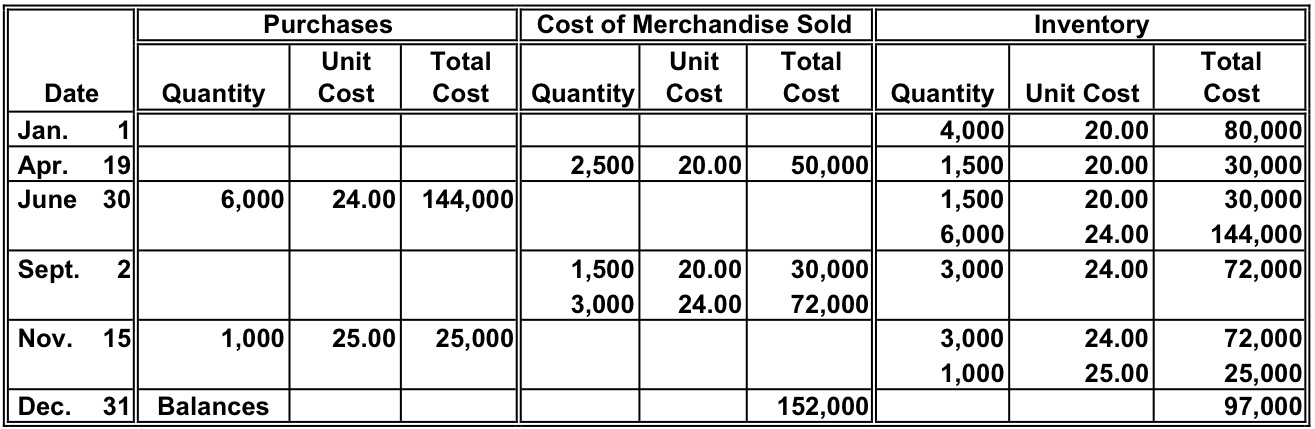
Cost of Merchandise Sold Unit  Total Unit  Total  Total Quantity Cost  Cost Quantity Cost  Cost Quantity Unit Cost  Cost  Jan. 14,000 20.00 80,000 Apr. 192,500 20.00 50,000 1,500 20.00 30,000 June 30 6,000 24.00 144,0001,500 20.00 30,000 6,000 24.00 144,000 Sept. 21,500 20.00 30,000 3,000 24.00 72,000 3,000 24.00 72,000 Nov. 15 1,000 25.00 25,0003,000 24.00 72,000 1,000 25.00 25,000 Dec. 31 Balances152,000 97,000

The following units of a particular item were available for sale during the calendar year: Jan. 1 Inventory 30,000 units at $30.00

The following units of a particular item were available for sale during the calendar year:

Jan.  1 Inventory 30,000 units at $30.00
Mar. 18 Sale 24,000 units
May  2 Purchase 54,000 units at $31.00
Aug.  9 Sale 45,000 units
Oct. 20 Purchase 21,000 units at $32.10

The firm uses the weighted average cost method with a perpetual inventory system. Determine the cost of merchandise sold for each sale and the inventory balance after each sale. Present the data in the form illustrated in Exhibit 5.


Answer:

Cost of Merchandise Sold Unit  Total Unit  Total  Total Quantity Cost  Cost Quantity Cost  Cost Quantity Unit Cost  Cost Jan. 130,000 30.00 900,000 Mar. 1824,000 30.00 720,000 6,000 30.00 180,000 May 2 54,000 31.00 1,674,00060,000 30.90 1,854,000 Aug. 945,000 30.90 1,390,500 15,000 30.90 463,500 Oct. 20 21,000 32.10 674,10036,000 31.60 1,137,600 Dec. 31 Balances2,110,500 36,000 31.60 1,137,600