Showing posts with label Chapter 23: Performance Evaluation Using Variances from Standard Costs. Show all posts

Friday, November 2, 2018

Alpha University wishes to monitor the efficiency and quality of its course registration process.

Alpha University wishes to monitor the efficiency and quality of its course registration process.

a. Identify three input and three output measures for this process.
b. Why would Alpha University use nonfinancial measures for monitoring this process?

Answer:
a.
Possible Input Measures
Registration staffing per student
Technology investment per period for registration process
Training hours per registration personnel
Amount of faculty staffing
Amount of technology capacity (size of computer, number of input lines) for registration process
Maintenance dollars spent on the registration system
Employee satisfaction score
Number of hours per day registration is available

Possible Output Measures
Cycle time for a student to register for classes
Number of times a course is unavailable
Number of separate registration events or steps (log-ons or line waits) per student
Number of times a replacement course was used by a student
Number of registration errors
Student satisfaction score with the registration process
Number of student complaints about registration process
Number of registration rework steps per student
Cost of registration per student
Number of personnel overtime hours during registration
Labor time variance for registration process (standard hours less actual hours at standard labor rate)
Number of computer registration failures


b. Alpha University is interested in not only the efficiency of the process but also the quality of the process. This means that the process must meet multiple objectives. The college wants this process to meet the needs of students, which means it should not pose a burden to students. Students should be able to register for classes quickly, get the courses they want, and avoid registration errors, hassles, and problems. Thus, the nonfinancial measures are used to balance the need for a cost-efficient process with one that will meet the needs of the student.

Diamond Inc. is an Internet retailer of woodworking equipment. Customers order woodworking equipment

Diamond Inc. is an Internet retailer of woodworking equipment. Customers order  woodworking equipment from the company, using an online catalog. The company  processes these orders and delivers the requested product from its warehouse. The company wants to provide customers with an excellent purchase experience in order to expand the business through favorable word-of-mouth advertising and to drive repeat business. To help monitor performance, the company developed a set of performance measures for its order placement and delivery process:

Average computer response time to customer “clicks”
Dollar amount of returned goods
Elapsed time between customer order and product delivery
Maintenance dollars divided by hardware investment
Number of customer complaints divided by the number of orders
Number of misfilled orders divided by the number of orders
Number of orders per warehouse employee
Number of page faults or errors due to software programming errors
Number of software fixes per week
Server (computer) downtime
Training dollars per programmer

a. For each performance measure, identify it as either an input or output measure related to the “order placement and delivery” process.

b. Provide an explanation for each performance measure.

Answer:
a. and b.
Input 
Measure 
Output 
Measure 
Explanation 
 X A measure of the speed of the 
ordering process. If the speed is 
too slow, we may lose customers. 
 X An important measure of customer 
satisfaction with the final product 
that was ordered. 
 X An important overall measure of 
process responsiveness. If the 
company is too slow in providing 
product, we may lose customers. 
X  A driver of the ordering system’s 
reliability and downtime. The 
maintenance dollars should be 
divided by the amount of hardware 
in order to facilitate comparison 
across time. 
 X An extreme measure of customer 
dissatisfaction with the ordering 
process. 
 X Incorrectly filled orders reduce the 
customer’s satisfaction with the 
order process. A measure of output 
quality of the process. 
X  This measure is related to the 
capacity of the warehouse relative 
to the demands placed upon it. 
This relationship will impact the 
delivery cycle time. 
 X The page errors will negatively 
impact the customer’s ordering 
experience. It’s a measure of 
process output quality. 
X  Software bugs reduce the 
effectiveness of the order 
fulfillment system; thus, fixes are 
an input that will improve the 
performance of the order fulfillment 
system. 
Server (computer) downtime X  A measure of computer system 
reliability. 
Training dollars per programmer X  Trained programmers should 
enhance the software’s 
responsiveness and reliability. 

The following data were taken from the records of Griggs Company for December 2014:

The following data were taken from the records of Griggs Company for December 2014:

Administrative expenses $100,800
Cost of goods sold (at standard) 550,000
Direct materials price variance—unfavorable 1,680
Direct materials quantity variance—favorable 560
Direct labor rate variance—favorable 1,120
Direct labor time variance—unfavorable  490
Variable factory overhead controllable variance—favorable 210
Fixed factory overhead volume variance—unfavorable 3,080
Interest expense 2,940
Sales 868,000
Selling expenses 125,000

Prepare an income statement for presentation to management.

Answer:


GRIGGS COMPANY 
Income Statement 
For the Month Ended December 31, 2014 
Sales $868,000 
Cost of goods sold—at standard 550,000 
Gross profit—at standard $318,000 
    F
avorable Unfavorable  
Less variances from standard cost:    
Direct materials price $ — $ 1,680  
Direct materials quantity 560 —  
Direct labor rate 1,120 —  
Direct labor time — 490  
Variable factory overhead controllable 210 —  
Fixed factory overhead volume — 3,080 3,360 
Gross profit   $314,640 
Operating expenses:    
Selling expenses  $125,000  
Administrative expenses  100,800 225,800 
Income from operations   $  88,840 
Other expense:    
Interest expense   2,940 
Income before income tax   $  85,900 

The Assembly Department produced 5,000 units of product during March. Each unit required 2.20 standard direct labor hours

The Assembly Department produced 5,000 units of product during March. Each unit
required 2.20 standard direct labor hours. There were 11,500 actual hours used in the Assembly Department during March at an actual rate of $17.60 per hour. The standard direct labor rate is $18.00 per hour. Assuming direct labor for a month is paid on the fifth day of the following month, journalize the direct labor in the Assembly Department on March 31.

Answer:

Mar. 31 Work in Process


 Direct Labor Time Variance 9,000  
  Direct Labor Rate Variance  4,600 
  Wages Payable

5,000 × 2.20 hrs. × $18.00 
Direct labor time variance: (11,500 – 11,000) × $18.00 = $9,000 U 
Direct labor rate variance: ($17.60 – $18.00) × 11,500 = $4,600 F 

11,500 hours × $17.60 per hour 

Cioffi Manufacturing Company incorporates standards in its accounts and identifies variances at the time the manufacturing costs are incurred.

Cioffi Manufacturing Company incorporates standards in its accounts and identifies variances at the time the manufacturing costs are incurred.

Journalize the entries to record the following transactions:

a. Purchased 2,450 units of copper tubing on account at $52.00 per unit. The standard price is $48.50 per unit.

b. Used 1,900 units of copper tubing in the process of manufacturing 200 air conditioners. Ten units of copper tubing are required, at standard, to produce one air conditioner.

Answer:


a. Materials

1
18,825  
Direct Materials Price Variance

8
,575  
Accounts Payable


 127,400 
Work in Process

97,000  

Direct Materials Quantity Variance
2M
aterials


200 × 10 units × $48.50 
(2,000 units – 1,900 units) × $48.50 
1,900 × $48.50 


Tannin Products Inc. prepared the following factory overhead cost budget for the Trim Department for July 2014

Tannin Products Inc. prepared the following factory overhead cost budget for the Trim Department for July 2014, during which it expected to use 20,000 hours for production:

Variable overhead cost:
Indirect factory labor $46,000
Power and light12,000
Indirect materials   20,000
Total variable overhead cost $ 78,000
Fixed overhead cost:
Supervisory salaries $54,500
Depreciation of plant and equipment 40,000
Insurance and property taxes    35,500
Total fixed overhead cost130,000
Total factory overhead cost$208,000


Tannin has available 25,000 hours of monthly productive capacity in the Trim Department under normal business conditions. During July, the Trim Department actually used 22,000 hours for production. The actual fixed costs were as budgeted. The actual variable overhead for July was as follows:

Actual variable factory overhead cost:

Indirect factory labor        $49,700
Power and light.               13,000
Indirect materials             24,000
Total variable cost           $86,700

Construct a factory overhead cost variance report for the Trim Department for July.

Answer:

TANNIN PRODUCTS INC. 
Factory Overhead Cost Variance Report—Trim Department 
For the Month Ended July 31, 2014 
Productive capacity for the month 25,000  hrs. 
Actual productive capacity used for the month 22,000  hrs. 
    B
udget 
(at actual 
production) 
Actual 
    
Indirect factory labor $  50,600 $  49,700 $   (900)  
Power and light 13,200 13,000 (200)  
Indirect materials 22,000 24,000  $  2,000 
Total variable factory     
overhead cost $ 85,800 $ 86,700   
Fixed factory overhead costs:     
Supervisory salaries $  54,500 $  54,500   
Depreciation of plant and     
equipment 40,000 40,000   
Insurance and property taxes 35,500 35,500   
Total fixed factory     
overhead cost $130,000 $130,000   
Total factory overhead cost $215,800 $216,700   
Total controllable variances   $(1,100) $ 2,000 
     
Net controllable variance—unfavorable    $ 900 
Volume variance—unfavorable:     
Idle hours at the standard rate for fixed factory overhead
2
:   
(25,000 hrs. – 22,000 hrs.) × $5.20    15,600 
Total factory overhead cost variance—unfavorable   $16,500 
     
The budgeted variable factory overhead costs are determined by multiplying 
22,000 hours by the variable factory overhead cost rate for each variable cost 
category. These rates are determined by dividing each budgeted amount 
(estimated at the beginning of the month) by the planned (budgeted) volume 
$50,600 = ($46,000 ÷ 20,000 hrs.) × 22,000 hrs. 
$13,200 = ($12,000 ÷ 20,000 hrs.) × 22,000 hrs. 
$22,000 = ($20,000 ÷ 20,000 hrs.) × 22,000 hrs. 
$130,000 
25,000 hrs. 
= $5.20 per hr. 

Alternative Computation of Overhead Variances 
Factory Overhead 
Actual costs 216,700 Applied costs 200,200 
Balance (underapplied)   16,500 [22,000 × ($3.90* + $5.20)] 
Actual 
Factory 
Overhead 
Budgeted Factory 
Overhead for Amount 
Produced 
$216,700 Variable cost (22,000 × $3.90)……………   $ 85,800 $200,200 
Fixed cost…………………………………   130,000 
Total………………………………………… $215,800 
$900 U $15,600 U 
Controllable   Volume 
Variance Variance 
$16,500 U 
Total Factory Overhead 
Cost Variance 
*$78,000 ÷ 20,000 hours budgeted at the beginning of the month 

The data related to Shunda Enterprises Inc.’s factory overhead cost for the production of 100,000 units of product are as follows:

The data related to Shunda Enterprises Inc.’s factory overhead cost for the production of 100,000 units of product are as follows:

Actual: Variable factory overhead$458,000
        Fixed factory overhead494,000
Standard: 132,000 hrs. at $7.30 ($3.50 for variable factory overhead) 963,600

Productive capacity at 100% of normal was 130,000 hours, and the factory overhead cost budgeted at the level of 132,000 standard hours was $956,000. Based on these data, the chief cost accountant prepared the following variance analysis:


Variable factory overhead controllable variance:
Actual variable factory overhead cost incurred $458,000
Budgeted variable factory overhead for 132,000 hours   462,000
Variance—favorable–$ 4,000
Fixed factory overhead volume variance:
Normal productive capacity at 100% 130,000 hrs.
Standard for amount produced  132,000
Productive capacity not used 2,000 hrs.
Standard variable factory overhead rate  ×   $7.30
Variance—unfavorable14,600
Total factory overhead cost variance—unfavorable $10,600


Identify the errors in the factory overhead cost variance analysis.

Answer:
In determining the volume variance, the productive capacity overemployed (2,000 hours) should be multiplied by the standard fixed factory overhead rate of $3.80 ($7.30 – $3.50) to yield a favorable variance of $7,600. The variance analysis provided by the chief cost accountant incorrectly multiplied the 2,000 hours by the total factory overhead rate of $7.30 per hour and reported it as unfavorable. 


A correct determination of the factory overhead cost variances is as follows: 
Variable factory overhead controllable variance: 
Actual variable factory overhead cost incurred……………………  $458,000 
Budgeted variable factory overhead for 132,000 
hours (132,000 × $3.50)………………………………………………   462,000 
Variance—favorable………………………………………………… $  (4,000) 
Fixed factory overhead volume variance: 
Productive capacity at 100%…………………………………………… 130,000 
hrs. 
Standard for amount produced………………………………………   132,000 hrs. 
Productive capacity overemployed………………………………… (2,000) hrs. 
× Standard fixed factory overhead rate………………………………   × $3.80 
Variance—favorable…………………………………………………     (7,600) 
Total factory overhead cost variance—favorable…………………… $(11,600) 

Blumen Textiles Corporation began January with a budget for 90,000 hours of production in the Weaving Department

Blumen Textiles Corporation began January with a budget for 90,000 hours of production in the Weaving Department. The department has a full capacity of 100,000 hours under normal business conditions. The budgeted overhead at the planned volumes at the beginning of April was as follows:

Variable overhead $540,000
Fixed overhead 240,000
Total $780,000

The actual factory overhead was $782,000 for April. The actual fixed factory overhead was as budgeted. During April, the Weaving Department had standard hours at actual production volume of 92,500 hours.

a. Determine the variable factory overhead controllable variance.
b. Determine the fixed factory overhead volume variance.

Answer:


a. Controllable variance: 
Actual variable factory overhead 
($782,000 – $240,000)……………………………  $542,000 
Standard variable factory overhead 
at actual production: 
Standard hours at actual production……… 92,500 
× Variable factory overhead rate
1
…………   $6.00 
Standard variable factory overhead…………   555,000 
Controllable variance—favorable………………  $(13,000) 
1 Variable factory overhead rate: $
540,000 
90,000 hrs. 
$240,000 
2 Fixed factory overhead rate: =   $2.40 per hour 
100,000 hrs. 
3 A
ctual Overhead – Applied Overhead = Total Overhead Variance: 
$782,000 – [($6.00 + $2.40) × 92,500 hrs.] = $5,000 

Alternative Computation of Overhead Variances 
Factory Overhead 
Actual costs 782,000 Applied costs 777,000 * 
Balance (underapplied)     5,000   
Actual 
Factory 
Overhead 
Budgeted Factory 
Overhead for Amount 
Produced 
$782,000 

Variable cost (92,500 × $6.00)………… $555,000 $777,000 * 
Fixed cost…………………………………     240,000 
Total……………………………………… $795,000 
–$13,000 F $18,000 U 
Controllable Volume 
Variance Variance 
* [($6.00 + $2.40) × 92,500] 

The following data relate to factory overhead cost for the production of 10,000 computers:

The following data relate to factory overhead cost for the production of 10,000 computers:

Actual: Variable factory overhead $262,000
Fixed factory overhead 90,000
Standard: 14,000 hrs. at $25 350,000

If productive capacity of 100% was 15,000 hours and the total factory overhead cost budgeted at the level of 14,000 standard hours was $356,000, determine the variable factory overhead controllable variance, fixed factory overhead volume variance, and total factory overhead cost variance. The fixed factory overhead rate was $6.00 per hour.

Answer:


Variable factory overhead controllable variance: 
Actual variable factory overhead cost incurred………………   $262,000 
Budgeted variable factory overhead for 14,000 hrs. 
[14,000 × ($25.00 – $6.00)]……………………………………   266,000 
Variance—favorable………………………………………… $(4,000) 
Fixed factory overhead volume variance: 
Productive capacity at 100%…………………………………… 15,000 
Standard for amount produced………………………………… 14,000 hrs. 
Productive capacity not used………………………………… 1,000 hrs. 
× Standard fixed factory overhead rate……………………… 
Variance—unfavorable……………………………………… 
Total factory overhead cost variance—unfavorable*……………   $ 2,000 
* Actual Overhead – Applied Overhead = Total Overhead Variance:    
($262,000 + $90,000) – $350,000 = $2,000 

Alternative Computation of Overhead Variances 
Factory Overhead 
Actual costs 352,000 Applied costs 350,000 
Balance (underapplied)     2,000   
Budgeted Factory 
Overhead for Amount 
Produced 
$352,000 Variable cost [14,000 × ($25.00 – $6.00)]………   $266,000 $350,000 
Fixed cost…………………………………………     90,000 
Total………………………………………………… $356,000 
–$4,000 F $6,000 U 
Controllable  Volume 
Variance Variance 
$2,000 U 
Total Factory Overhead 
Cost Variance 

Wiki Wiki Company has determined that the variable overhead rate is $4.50 per direct labor hour in the Fabrication Department

Wiki Wiki Company has determined that the variable overhead rate is $4.50 per direct labor hour in the Fabrication Department. The normal production capacity for the Fabrication Department is 10,000 hours for the month. Fixed costs are budgeted at $60,000 for the month.

a. Prepare a monthly factory overhead flexible budget for 9,000, 10,000, and 11,000 hours of production.

b. How much overhead would be applied to production if 9,000 hours were used in the department during the month?

Answer:


a. 
b. Overhead applied at actual production:  
 Actual hours…………………………………………………………………………… 9,000 
 × Overhead application rate*……………………………………………………… $  10.50 
 Factory overhead applied………………………………………………………… $94,500 
* Total factory overhead rate to be applied to production: 
Variable factory overhead………………………………………………… $ 4.50 
Fixed factory overhead**…………………………………………………    6.00 
Total……………………………………………………………………………  $10.50 
$60,000 
** Fixed factory overhead rate: =  $6.00 per hr. 
10,000 hrs. 
Note: The fixed factory overhead rate is determined at normal production. 

Leno Manufacturing Company prepared the following factory overhead cost budget for the Press Department

Leno Manufacturing Company prepared the following factory overhead cost budget for the Press Department for October 2014, during which it expected to require 20,000 hours of productive capacity in the department:


Variable overhead cost:
Indirect factory labor $180,000
Power and light12,000
Indirect materials  64,000
Total variable overhead cost $256,000
Fixed overhead cost:
Supervisory salaries $ 80,000
Depreciation of plant and equipment 50,000
Insurance and property taxes   32,000
Total fixed overhead cost 162,000
Total factory overhead cost $418,000


Assuming that the estimated costs for November are the same as for October, prepare a flexible factory overhead cost budget for the Press Department for November for 18,000, 20,000, and 22,000 hours of production.

Answer:


LENO MANUFACTURING COMPANY 
Factory Overhead Cost Budget—Press Department 
For the Month Ended November 30, 2014 
Direct labor hours 18,000 20,000 22,000 
Variable overhead cost:    
Indirect factory labor $162,0001
 P
ower and light 10,800
2 I
ndirect materials 57,6003
 T
otal variable factory overhead $230,400 $256,000 $281,600 
Fixed factory overhead cost:    
Supervisory salaries $  80,000 $  80,000 $  80,000 
Depreciation of plant and equipment 50,000 50,000 50,000 
Insurance and property taxes 32,000 32,000 32,000 
Total fixed factory overhead $162,000 $162,000 $162,000 
Total factory overhead $392,400 $418,000 $443,600 
    
18,000 × ($180,000 ÷ 20,000) 
18,000 × ($12,000 ÷ 20,000) 
18,000 × ($64,000 ÷ 20,000) 


At the beginning of June, Veneskey Printing Company budgeted 19,200 books to be printed in June at standard direct materials

At the beginning of June, Veneskey Printing Company budgeted 19,200 books to be printed in June at standard direct materials and direct labor costs as follows:

Direct materials $36,000
Direct labor 26,880
Total $62,880

The standard materials price is $1.25 per pound. The standard direct labor rate is $14.00 per hour. At the end of June, the actual direct materials and direct labor costs were as follows:

Actual direct materials $34,500
Actual direct labor 24,500
Total $59,000

There were no direct materials price or direct labor rate variances for June. In addition, assume no changes in the direct materials inventory balances in June. Veneskey Printing Company actually produced 18,000 units during June.

Determine the direct materials quantity and direct labor time variances.

Answer:

Step 1:  Determine the standard direct materials and direct labor per unit. 
Standard direct materials quantity per unit: 
Direct materials lbs. budgeted for June: 
$36,000 
$1.25 per lb. 
=  28,800 lbs. 
Standard pounds per unit: 
28,800 lbs. 
19,200 units 
=  1.5 standard lbs. per unit 
Standard direct labor time per unit: 
Direct labor hrs. budgeted for June: 
$26,880 
$14.00 per hr. 
=  1,920 direct labor hrs. 
Standard direct labor hrs. per unit: 
1,920 hrs. 
19,200 units 
=  0.10 standard direct labor hr. per unit 
Step 2:  Using the standard quantity and time rates in step 1, determine the 
standard costs for the actual June production. 
Standard direct materials at actual volume: 
18,000 units × 1.5 lbs. per unit × $1.25…………………………………………… $33,750 
Standard direct labor at actual volume: 
18,000 units × 0.10 direct labor hr. per unit × $14.00…………………………    25,200 
Total………………………………………………………………………………………… $58,950 
Step 3:  Determine the direct materials quantity and direct labor time variances, 
assuming no direct materials price or direct labor rate variances. 
Actual direct materials used in production………………………………………… $34,500 
Standard direct materials (step 2)……………………………………………………   33,750 
Direct materials quantity variance—unfavorable*………………………………… $  750 
* (27,600 lbs. – 27,000 lbs.) × $1.25 = 750 U 
$34,500 ÷ $1.25 = 27,600 lbs. 
$33,750 ÷ $1.25 = 27,000 lbs. 
Actual direct labor……………………………………………………………………… $24,500 
Standard direct labor (step 2)…………………………………………………………   25,200 
Direct labor time variance—favorable**…………………………………………… $    (700) 
** 18,000 units × 0.10 hr. = 1,800 standard hrs. 
$24,500 ÷ $14.00 = 1,750 actual hrs. 
(1,750 hrs. – 1,800 hrs.) × $14.00 = –$700 F 

One of the operations in the United States Postal Service is a mechanical mail sorting operation

One of the operations in the United States Postal Service is a mechanical mail sorting operation. In this operation, letter mail is sorted at a rate of two letters per second. The letter is mechanically sorted from a three-digit code input by an operator sitting at a keyboard. The manager of the mechanical sorting operation wishes to determine the number of temporary employees to hire for December. The manager estimates that there will be an additional 41,472,000 pieces of mail in December, due to the upcoming holiday season.

Assume that the sorting operators are temporary employees. The union contract requires that temporary employees be hired for one month at a time. Each temporary employee is hired to work 160 hours in the month.

a. How many temporary employees should the manager hire for December?
b. If each employee earns a standard $15 per hour, what would be the labor time variance if the actual number of letters sorted in December was 41,220,000?

Answer:


a. 
Standard Sorts per Minute × 
Standard Minutes per Hour   = 
Standard Sorts per Hour 
(per employee) 
120 sorts per min. × 60 min. per hr. =   7,200 standard sorts per hr. 
Pieces of Mail ÷ 
Standard Sorts per Hour 

=   Number of Hours Planned 
41,472,000 letters ÷ 7,200 sorts per hr. =   5,760 hrs. planned 
Number of Hours Planned ÷ 
Hours per Temporary Employee per Month 

=   Number of Hires 
5,760 hrs. ÷ 160 hrs.   = 36 temporary hires for December 
b. Actual pieces sorted = 41,220,000 
Actual Pieces of Mail Sorted ÷ 
Standard Sorts per Hour 

=   Standard Number of Hours 
for Actual Production 
41,220,000 ÷ 7,200 standard sorts per hr. = 5,725 standard hrs. for actual 
production 
Actual hours staffed……………………………………………………………… 5,760 
Standard hours for actual production………………………………………   5,725 
Excess of actual over standard hours……………………………………… 35 
× Standard hourly rate…………………………………………………………… $  15 
Direct labor time variance—unfavorable……………………………………… $   525 

Englert Hospital began using standards to evaluate its Admissions Department. The standard was broken

Englert Hospital began using standards to evaluate its Admissions Department. The standard was broken into two types of admissions as follows:

                      Standard Time to Complete
Type of admission         admission Record
Unscheduled admission          30 min.
Scheduled admission            15 min.

The unscheduled admission took longer, since name, address, and insurance information needed to be determined and verified at the time of admission. Information was collected on scheduled admissions prior to the admissions, which was less time consuming.

The Admissions Department employs four full-time people (40 productive hours per
week, with no overtime) at $15 per hour. For the most recent week, the department handled 140 unscheduled and 350 scheduled admissions.

a. How much was actually spent on labor for the week?
b. What are the standard hours for the actual volume for the week?
c. Calculate a time variance, and report how well the department performed for the week.

Answer:


a.  Actual weekly expenditure:  4 people × $15.00 per hour × 40 hrs. per week = $2,400 
b.  Standard time used for the volume of admissions: 
Unscheduled Scheduled 
Number of admissions……… 140 350 
× Standard time……………   30 min.   15 min. 
Total 
Total……………………………   4,200 min.  5,250 min. 9,450 min. or 
(157.5 hrs. × 60 min.) 
c.  Actual productive minutes available 
  (4 employees × 40 hrs. × 60 min.)............................. 9,600 minutes  
 Less standard minutes used at actual volume............ 9,450 minutes  
 Time difference from standard ...................................... 150 minutes 
 × Standard rate per minute
1
 ........................................... $  0.25 
 Direct labor time variance—unfavorable ..................... $37.50 
 or 
[(4 × 40 hours) – 157.5 hours] × $15 per hour = $37.50 
or 
$2,400 [from (a)] – $2,362.50
2  
= $37.50 

Standard direct labor rate: 
$15 ÷ 60 min. = $0.25 per min. 

Standard labor cost at actual volume: 
Productive time (9,450 ÷ 60) × $15 = $2,362.50 
The Admissions Department was less efficient than standard by 150 minutes, 
or 2.5 hours. This is equal to $37.50 at the standard rate of $15 per hour. 

The Greeson Clothes Company produced 25,000 units during June of the current year

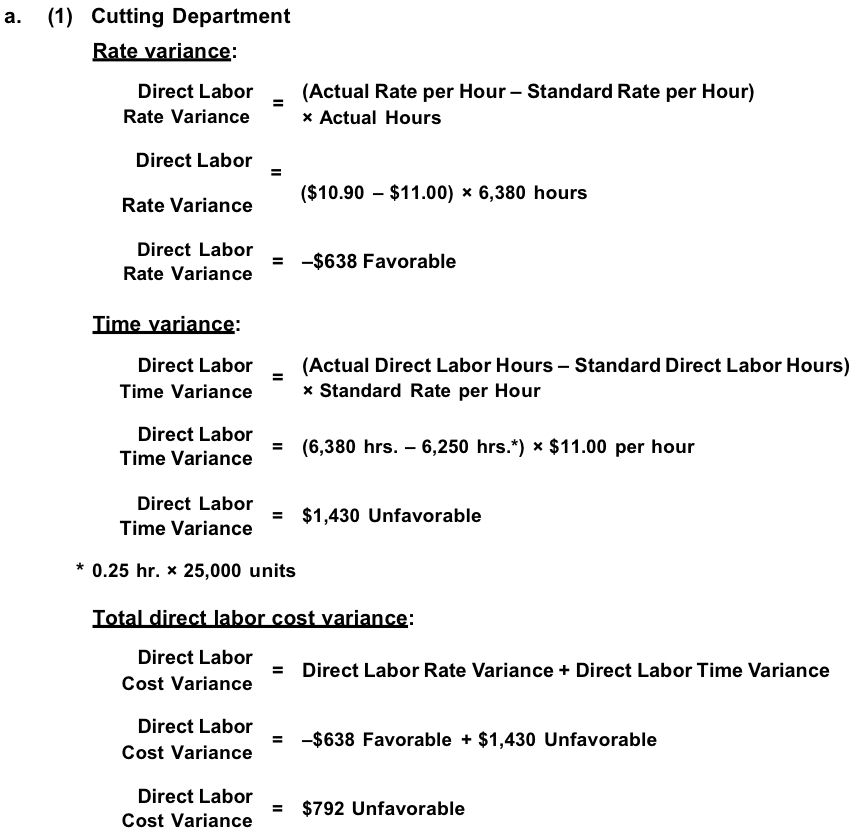
The Greeson Clothes Company produced 25,000 units during June of the current year. The Cutting Department used 6,380 direct labor hours at an actual rate of $10.90 per hour. The Sewing Department used 9,875 direct labor hours at an actual rate of $11.12 per hour. Assume there were no work in process inventories in either department at the beginning or end of the month. The standard labor rate is $11.00. The standard labor time for the Cutting and Sewing departments is 0.25 hour and 0.4 hour per unit, respectively.

a. Determine the direct labor rate, direct labor time, and total direct labor cost variance for the (1) Cutting Department and (2) Sewing Department.

b. Interpret your results.

Answer:


a. (1)   Cutting Department 
Rate variance: 
Direct Labor 
Rate Variance    =

(Actual Rate per Hour – Standard Rate per Hour) 
× Actual Hours 
Direct Labor   =

Rate Variance ($10.90 – $11.00) × 6,380 hours 
Direct Labor 
Rate Variance 
Time variance: 
Direct Labor 
Time Variance 

=   –$638 Favorable 

=   (Actual Direct Labor Hours – Standard Direct Labor Hours) 
× Standard Rate per Hour 
Direct Labor 
Time Variance 
Direct Labor 
Time Variance 

=   (6,380 hrs. – 6,250 hrs.*) × $11.00 per hour 
=   $1,430 Unfavorable 
* 0.25 hr. × 25,000 units 
Total direct labor cost variance: 
Direct Labor 
Cost Variance 
Direct Labor 
Cost Variance 

=   Direct Labor Rate Variance + Direct Labor Time Variance 
=   –$638 Favorable + $1,430 Unfavorable 
Direct Labor 
Cost Variance 

=   $792 Unfavorable 

(2)   Sewing Department 
Rate variance: 
Direct Labor 
Rate Variance   = 
(Actual Rate per Hour – Standard Rate per Hour) 
× Actual Hours 
Direct Labor    =

Rate Variance (
$11.12 – $11.00) × 9,875 hours 
Direct Labor 
Rate Variance 
Time variance: 
Direct Labor 
Time Variance 

=   $1,185 Unfavorable 

=   (Actual Direct Labor Hours – Standard Direct Labor Hours) 
× Standard Rate per Hour 
Direct Labor 
Time Variance 

=   (9,875 hrs. – 10,000 hrs.*) × $11.00 per hour 
Direct Labor 
Time Variance 

=   –$1,375 Favorable 
* 0.40 hr. × 25,000 units 
Total direct labor cost variance: 
Direct Labor 
Cost Variance    =


Direct Labor Rate Variance + Direct Labor Time Variance 
Direct Labor 
Cost Variance 

=   $1,185 Unfavorable – $1,375 Favorable 
Direct Labor 
Cost Variance 

=   –$190 Favorable 
b. The two departments have opposite results. The Cutting Department has a 
favorable rate and an unfavorable time variance, resulting in a total unfavorable 
cost variance of $792. In contrast, the Sewing Department has an unfavorable rate 
variance, but has a favorable time variance, resulting in a total favorable cost 
variance of $190. The causes of this disparity are worthy of investigation. There 
are many possible causes including tight or loose standards, inferior or superior 
operating methods, and inappropriate or appropriate use of overtime. Combining 
both departments, the overall operation shows an unfavorable cost variance of $602 
($792 – $190), as a result of the weak performance in the Cutting Department. 

Hoschild Bicycle Company manufactures bicycles. The following data for September of the current year are available:

Hoschild Bicycle Company manufactures bicycles. The following data for September of the current year are available:

Quantity of direct labor used 850 hrs.
Actual rate for direct labor $15.60 per hr.
Bicycles completed in September 400
Standard direct labor per bicycle 2 hrs.
Standard rate for direct labor $16.00 per hr.

a. Determine the direct labor rate and time variances.
b. How much direct labor should be debited to Work in Process?

Answer:


a. Rate variance: 
Direct Labor 
Rate Variance 
Direct Labor 
Rate Variance 
Direct Labor 
Rate Variance 
Time variance: 
Direct Labor 
Time Variance 
Direct Labor 
(Actual Rate per Hour – Standard Rate per Hour) 
=   ×
 Actual Hours 
=   ($15.60 – $16.00) × 850 hrs. 
=   –$340 Favorable 

=   (Actual Direct Labor Hours – Standard Direct Labor Hours) 
× Standard Rate per Hour 
=

Time Variance (850 hrs. – 800 hrs.*) × $16.00 per hour 
Direct Labor 
Time Variance 

=   $800 Unfavorable 
* 2.00 hrs. × 400 units 
Total direct labor cost variance: 
Direct Labor 
Cost Variance    = 

Direct Labor Rate Variance + Direct Labor Time Variance 
Direct Labor 
Cost Variance 
Direct Labor 
Cost Variance 

=   –$340 Favorable + $800 Unfavorable 
=   $460 Unfavorable 
b. Debit to Work in Process:  $12,800  
 Standard hours at actual production………………………………………… 800 
 × Standard rate…………………………………………………………………… $  16.00 
 Standard direct labor cost……………………………………………………… $12,800 

The following data relate to labor cost for production of 8,000 cellular telephones:

The following data relate to labor cost for production of 8,000 cellular telephones:

Actual: 4,050 hrs. at $20.00 $81,000
Standard: 4,000 hrs. at $20.40 $81,600

a. Determine the direct labor rate variance, direct labor time variance, and total direct labor cost variance.

b. Discuss what might have caused these variances.

Answer:

a. Rate variance: 
Direct Labor 
Rate Variance 
Direct Labor 
Rate Variance 
Direct Labor 
Rate Variance 
(Actual Rate per Hour – Standard Rate per Hour) 
=   × Actual Hours 
=   ($20.00 – $20.40) × 4,050 hours 
=   –$1,620 Favorable 
Time variance: 
Direct Labor 
Time Variance 
Direct Labor 
Time Variance 
Direct Labor 
Time Variance 

=   (Actual Direct Labor Hours – Standard Direct Labor Hours) 
× Standard Rate per Hour 
=   (4,050 hrs. – 4,000 hrs.) × $20.40 per hour 
=   $1,020 Unfavorable 
Total direct labor cost variance: 
Direct Labor 
Cost Variance 
Direct Labor 
Cost Variance 
Direct Labor 
Cost Variance 

=   Direct Labor Rate Variance + Direct Labor Time Variance 
=   –$1,620 Favorable + $1,020 Unfavorable 
=   –$600 Favorable 
b. The employees may have been less experienced workers who were paid less than 
more experienced workers or poorly trained, thereby resulting in a lower labor rate 
than planned. The lower level of experience or training may have resulted in less 
efficient performance. Thus, the actual time required was more than standard. 
Fortunately, the lost efficiency is more than offset by the lower labor rate. 


H.J. Heinz Company uses standards to control its materials costs. Assume that a batch of ketchup (1,880 pounds)

H.J. Heinz Company uses standards to control its materials costs. Assume that a batch of ketchup (1,880 pounds) has the following standards:

                   Standard Quantity | Standard price
Whole tomatoes      3,360 lbs. | $ 0.50 per lb.
Vinegar                      220 gal. | 3.00 per gal.
Corn syrup                   20 gal. | 12.00 per gal.
Salt                               80 lbs. | 3.00 per lb.

The actual materials in a batch may vary from the standard due to tomato characteristics. Assume that the actual quantities of materials for batch K-54 were as follows:

3,556 lbs. of tomatoes
  230 gal. of vinegar
   18 gal. of corn syrup
   75 lbs. of salt

a. Determine the standard unit materials cost per pound for a standard batch.
b. Determine the direct materials quantity variance for batch K-54.

Answer:


a. 
Standard 
Quantity × 
Standard 
Price = 
Standard 
Cost per 
Batch 
Whole tomatoes……… 3,360 lbs. $  0.50 per lb. $1,680 
Vinegar………………… 220 gal. 3.00 per gal. 660 
Corn syrup…………… 20 gal. 12.00 per gal. 240 
Salt…………………… 80 lbs. 3.00 per lb.   240 
   $2,820 
÷ Pounds per batch……………………………………………   1,880  lbs. 
$  1.50  per lb. 
b. Actual 
Quantity for 
Batch K-54 

– 
Standard 
Quantity per 
Batch 


Quantity 
Difference 

× 

Standard 
Price 


Materials 
Quantity 
Variance 
3,556 lbs. 
230 gal. 
18 gal. 
75 lbs. 
 3,360 lbs. 
220 gal. 
20 gal. 
80 lbs. 
 196 lbs. 
10 gal. 
(2) gal. 
(5) lbs. 
 $  0.50 per lb. 
3.00 per gal. 
12.00 per gal. 
3.00 per lb. 
 $98 U 
30 U 
–24 F 
–15 F 
        $89 U 

The following data relating to direct materials cost for October of the current year are taken from the records of Good Clean Fun Inc., a manufacturer of organic toys:

The following data relating to direct materials cost for October of the current year are taken from the records of Good Clean Fun Inc., a manufacturer of organic toys:

Quantity of direct materials used 3,000 lbs.
Actual unit price of direct materials $5.50 per lb.
Units of finished product manufactured 1,400 units
Standard direct materials per unit of finished product 2 lbs.
Direct materials quantity variance—unfavorable $1,000
Direct materials price variance—unfavorable $1,500

Determine the standard direct materials cost per unit of finished product, assuming that there was no inventory of work in process at either the beginning or the end of the month.

Answer:


Product finished………………………………………………………… 1,400  units 
Standard finished product for direct materials used 
(3,000 lbs. ÷ 2 lbs.)…………………………………………………… 1,500 
Deficiency of finished product for materials used……………   (100) units 
Standard cost for direct materials: 
Quantity variance divided by deficiency of product 
for materials used ($1,000 ÷ 100 units)………………………  $10.00  per unit 
Alternate solution: 
Price variance, unfavorable……………………………………… $1,500 
Materials used……………………………………………………… ÷   3,000  lbs. 
Price variance per lb., unfavorable……………………………… $  0.50 
Unit price of direct materials…………………………………… $  5.50 
Less price variance (unfavorable) per lb. (from above)………    (0.50) 
Standard price per lb.………………………………………………  $  5.00 
× Pounds per unit of product……………………………………   2 
Standard direct materials cost per unit of product………… $10.00 
Proof: 
Direct Materials Price Variance =  (Actual Price – Standard Price) × Actual Quantity 
=  ($5.50 – $5.00) × 3,000 
=  $1,500 Unfavorable 
Direct Materials Quantity Variance =  (Actual Quantity – Standard Quantity) 
× Standard Price 
=  (3,000 lbs. – 2,800 lbs.) × $5.00 
=  $1,000 Unfavorable